
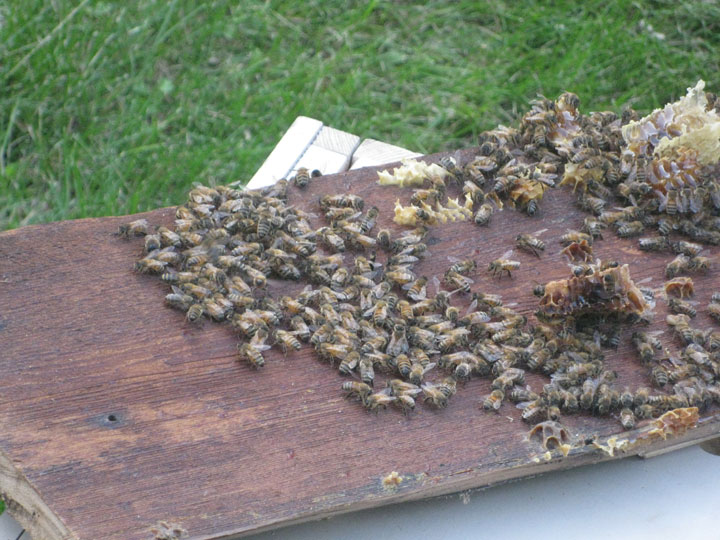
Last night, the wonderful bee keepers came to our house around 6:30 pm and left at 10 pm with tubs full of bees, honeycomb and honey! Thanks to Swarmbusters we have 50,000 less house guests. Their card says, "Who you gonna call?" Funny! I guess you've got to have a sense of humor when you're a bee keeper.
When they arrived, they listened to our walls with a stethoscope to determine where the largest concentration of bees were. They decided to go out the upstairs window and onto the roof and cut a hole in the siding to get to the hive.

They were looking for the queen but never found her. They cut out the bee-covered honeycomb and filled up at least two Rubbermaid tubs with the sticky stuff.

Once they got all of the honeycomb out, they used a shop vac to vacuum out the remaining bees. Thank you so much, Steve, Roxi and Vern!

Stuff I learned about bees (that I didn’t know I wanted to know):
- Bee removal experts hope to find the queen but only find her 1 in 10 times. If they do find the queen, all the other bees go to her which makes moving the hive much easier.
- It’s against the law in Michigan for an exterminator to kill honeybees.
- Older honeycomb is a dark, almost brown color. New honeycomb is very light yellow, almost white.
- Honey bees really do only sting once and then they die so they only sting as a last resort. They will sometimes dive and bounce off of you, as a warning.
- Honeybees have different jobs - think Bee Movie. There are guard bees that stay outside the hive. Guard bees have the most venom. The worker bees that usually always stay in the hive have only a little bit of venom and then there are the drones (male bees) that have no stinger. The bee’s stinger can continue pumping venom into it’s victim for 30 seconds which is why it’s important to get the stinger out.
- All male bees do is eat honey and mate with the queen. Once they mate, they die. In the winter, all male bees are kicked out of the hive to starve and die.
- The worker bees only live 8 weeks. So the queen is having babies all summer. The baby bees look like a grub or maggot. They are put in a chamber in the honey comb and sealed off until they are mature.
- In the winter, the bees generate enough heat to keep the hive at 90 degrees. They live off the honey they made until they can make more honey in the spring.
- Honey is only gathered once or twice a year. Usually in July and then maybe in the fall, if there was a good August crop and the bees were able to get food from the blossoming plants.
- The hum of 50,000 stirred up bees kind of sounds like the hum of a fluorescent light bulb.


